|
SWC (Free) Walks
Walk 67 : Salisbury to Amesbury via Stonehenge
A walk up the Avon valley with a magical approach to Stonehenge
| Length
| Full walk 23 kms (14.3 miles) from Salisbury to Amesbury including sightseeing, or 18 kms (11.2 miles) from Old Sarum. A shortcut skirting Stonehenge saves a further 2 kms (1.25 miles) bringing the minimum down to approximately 16 kms (10 miles) plus whatever sightseeing you wish to do.
|
| Toughness
| From 4 to 6 out of 10 solely due to the distance. There are no steep hills.
|
| Features
| Salisbury Cathedral is probably best visited before the walk. From Salisbury the walk climbs gently to Old Sarum, then criss-crosses the River Avon and passes by the country mansion of the rock star Sting to rise gently again to Stonehenge by what some would say is a magical approach. Stonehenge is of course one of Britain's most iconic landmarks. You have to walk a further 4 kms into Amesbury via The Avenue which makes this a long walk but even this is not without interest being the route by which the bluestones may have been brought to Stonehenge from the River Avon. You return by bus from Amesbury. If you intend to do the full tour of Salisbury Cathedral beforehand it is suggested you take the bus to Old Sarum to catch up with the rest of the group (Wilts and Dorset Bus No.5/6). The walk is timed to get you to Stonehenge by about 5pm including 1 hour for lunch.
|
| Walk Options
|
- You can shorten the walk by catching the bus to, or parking at, Old Sarum, saving 3 kms. The Bus Nos 5/6 runs half-hourly from the city centre bus station on Saturdays, 1.5 hourly on Sundays. You can also shortcut Stonehenge (see below), saving a further 2 kms.
- Non-walking partners could catch a different tourist bus from Salisbury that makes a round trip to Stonehenge via Old Sarum on the outward journey (£11 return or £18 including admission to both English Heritage sites). Tickets from the Tourist Information Office in Fish Row. However you will not have the same experience as the walkers who approach Stonehenge via an ancient trackway through a bronze age landscape. National Trust members can get into the Stonehenge enclosure for free but not into Old Sarum's inner castle.
|
| Transport
| Salisbury has a half-hourly train service from Waterloo (journey time about 1 hour 22 mins). The return bus No.5/6 or Activ8 runs frequently from Amesbury to Salisbury on Saturdays and approximately 1.5 hourly on Sundays (journey time about 20 minutes, plus a 10-15 minute walk to the station). Cost about £3.70. From Stonehenge you could call for a taxi. Amesbury Taxis 01980 626 666. 1st Choice Cabs 01980 622 666. Kaytom Cabs 01980 626 261.
|
| Saturday Walkers Club
| Take the train closest to 9:20 from Waterloo.
|
| Maps
| It is not necessary but it is recommended to take OS Explorer Map 130 (1:25,000). Alternatively OS Landranger Map 184 (1:50,000) but several paths are not shown on that map. (Explorer maps additionally show fence and field boundaries and footpaths are marked in green as opposed to red on Landranger.) The links below may substitute for the real thing.
|
| Lunch
| Recommended – The Wheatsheaf Inn, Lower Woodford. Tel: 01722 782 203. A large pub. Mains £8-£12. Booking required for large groups. All day food.
Gastro-pub alternative – The Bridge Inn, Upper Woodford. Tel: 01722 782 323. Modern British Food. Mains £12-£17, starters £7.
Quirky – The Black Horse Inn. Tel:01722 782 270. 6-8 people max. Mains £9-£17. Last Orders 1:45pm Saturday, closes 2pm; 2:45pm Sunday, closes 3pm.
|
| Tea
| Stonehenge Visitor Centre. See Stonehenge hours of opening.
Friar Tuck Café, Salisbury Street, Amesbury. Last orders 4.45pm.
The George, High Street, Amesbury.
There are many pubs and restaurants in Salisbury. The Mill is recommended.
|
| Driving
| If travelling by car you could park in one of the city centre car parks, or at Old Sarum. Note that the Old Sarum car park run by English Heritage closes as early as 4pm in winter and at 6pm in summer and is therefore unsuitable for this purpose; however, the residential roads nearby may be. There is also a Park and Ride car park nearby, The Beehive. You return by bus with the rest of the group (not Activ8 bus which does not ordinarily stop at Old Sarum or The Beehive).
|
| Links
| Visit Wiltshire/Salisbury
Visit Britain/Salisbury
Time-Travel/Amesbury
Sting for your Supper
|
Walking Instructions
- The timing of this walk with a start from London Waterloo at 09:20 has been designed so that you arrive at lunch at about 1:30pm and at Stonehenge at approximately 5pm. (Note that between 16th October and 15th March, Stonehenge, Visitor Centre and Cafe close promptly at 4pm. At other times of the year it is open until at least 6pm.) See their website Stonehenge. It is another one hour's walking into Amesbury, alternatively you could summon up a taxi. (See transport details).
- [Map 1] Salisbury Station to Riverside Walk. Turn left out of the station, walk down the slope to cross the zebra crossing and continue down Fisherton Street in the direction of the finger posts towards the city centre. At this point you have two options.
Option 1. You can go walkabout in Salisbury and then take one of many buses that go to Old Sarum from the Bus Station to meet up with the rest of the group. Follow the signposts for the Cathedral or the Tourist Information Office. A recommended route is to go straight to the Cathedral by turning right down Water Lane then left along Crane Bridge Lane then right down the High Street to enter Cathedral Close. Return back along the High Street and over the crossing to continue on High Street and follow the signposts for Riverside Walk. (You could divert to the Tourist Office in Fish Row, or the open air market in Market Square on Saturdays from here). The Bus Station should you wish to find it is north-east of Market Square on Endless Street. Buses to Old Sarum leave about every 30 minutes (Mon-Sat). This saves a 3 km walk which the rest of the group will do in about 45 minutes so they will be at Old Sarum around noon, leaving at about 12:30pm to get to the Wheatsheaf Inn at about 1:15pm. Add additional time if you go inside the Cathedral or inside the castle walls at Old Sarum.
Option 2. The direct route is to continue down Fisherton Street until you meet the High Street then find the fingerposts pointing to the Riverside Walk. However it seems a shame not to at least go down the High Street to see the tallest Cathedral tower in Britain.
- [Map 2] and [Map 3] Riverside Walk to Stratford-sub-Castle and Old Sarum. Follow the Riverside Walk signs. Follow this path shared cycle way alongside the river, across several minor roads and under road bridges. After 1.5 kms where the path bears a sharp left and before it turns into a gravel path, turn right across the river over a wide wooden footbridge with Five Rivers Leisure Centre in front of you. Then turn left along a well worn footpath with the river now on your left. This is grandly called the Avon Valley Nature Reserve. [!] Do not follow the FP sign to Stratford sub Castle – that path is uninteresting – though you rejoin it later. Follow this path for 1 km ignoring paths off to the right for higher ground, until the path itself swings right and regains the cycle way. Turn left onto the cycleway to emerge onto Stratford Road where you turn right (The Golden Way). Cross this road as soon as it is safe, passing a thatched stone cottage on your left to take an ancient trackway (The Portway) to Old Sarum. Continue straight past the 'William Pitt Stone' which indicates the rotten nature of the borough, ignore FP to left, continue for 300 metres to pass through a gap in the hedge still straight ahead uphill, ignore another FP to left, continue nearly to the main road at the top. Turn left along track before the main road, through wooden gate; bear right and then sharp left up the tarmac road into the car park of Old Sarum where there are also public toilets. Those coming by bus from the city centre could meet the group here.
Old Sarum. The original Salisbury, a castle and at one time a Roman Fort, also has cathedral remains and many notice boards with historical detail. Entrance to the castle inner ramparts is charged by English Heritage. Admission £3. Closed 24th-26th December and 1st January. Walk around either side to visit the old Cathedral remains with notice boards before descending to the north west.
- [Map 4] and [Map 5] Old Sarum to Little Durnford and The Wheatsheaf Inn. To the north west of the old Cathedral is a dip in the embankment and a causeway crossing the ramparts. Take this and descend to the outer rampart where you turn right passing through a wooden gate. After approximately 200 metres turn sharp left to descend the steep grassy bank to a stile onto the road below. [!] Slippery in wet weather. You could also walk a little further along the outer rampart to find a slightly less steep slope and then walk diagonally back to a second available stile onto the road. The road runs east-west below you. Turn right and after either one or two hundred metres (depends on which stile you crossed), cross the road to take the Wiltshire Cycleway (NCN 45) and Footpath northwards. Follow this for 1.75 kms passing Shepherds Corner on your left until you descend slightly and reach Keeper's Cottage, a small thatched cottage where you have a choice. If you really want to save 2 kms and bypass the recommended lunch stop then walk straight on. (Go straight to Option 2 below). However it is strongly recommended that whether you wish to take lunch or not, that you do take the main route to the Wheatsheaf Inn. Perhaps the prettiest and most scenic views of the river are this way.
Option 1, to the Wheatsheaf Inn. Large groups should head for the Wheatsheaf or if you are running late, because they serve food all day from noon. Directions: Turn left (south-west) down The Avenue, a wide tree-lined driveway, to pass Little Durnford Manor. Cross a minor road and pass through a white painted gate (operated by a green button) to snake past Home Farm, with a lovely view behind you across the River Avon. Continue on this private road (sometimes there is a single bar metal barrier gate across this driveway). Continue for a further 200 metres and 10 metres before a small stone bridge, descend from the road to pass through a white painted wooden swing gate on your right hand side into a field beside a stream on a permissive path. Continue in a NNW direction, crossing the stream by a footbridge and several stiles until you meet a minor road. Go half right here and walk for 1 km along this road (!fast traffic) to reach the Wheatsheaf Inn. The Wheatsheaf Inn has simple food at affordable prices or alternatively a more expensive menu.
After lunch at the Wheatsheaf turn left out of the pub taking the road northwards for 0.5 km until you find a FP sign on your right, pass over a cattle grid and along a gravel driveway in front of a large house and then across the River Avon by several footbridges. At the end of the track which gradually ascends to a road, turn left and after then after 30 metres take the farm track half right (NNW) past Salterton Farm in a north-easterly direction.
Option 2, if by-passing The Wheatsheaf Inn. At Keeper's Cottage, continue straight on rising up onto open fields for 800 metres. Where the trackway crosses a line of trees, take the Monarchs Way west to traverse the hillside down to Salterton Farm where you rejoin the shared route onwards to Upper Woodford.
- [Map 6] and [Map 7] Salterton Farm to Upper Woodford and The Bridge Inn. At Salterton Farm, take the farm track NNW up the hill past the farm buildings and where the track swings sharp right (Eddie's Bench "A seat for you to sit and ponder...") take FP north with the field edge on your left to reach a tubular steel gate and then traverse the hill down through woods emerging over a stile onto a minor road, where you turn right, to progress through the hamlet of Netton. Ignore three turnings off to the right and pass a wattle and daub building with thatched roof on your left hand side called Cabbage Cottage, to reach Woodford Bridge after 1.25 kms and The Bridge Inn, an alternative if a little pricey lunch stop. It has a riverside garden. This is your last opportunity for a pub lunch unless you are here by 1:15 on a Saturday or 2:15 on a Sunday because the next pub at Great Durnford in another 2 kms closes at 1:45 and 2:45 respectively.
- [Map 8] Woodford Bridge to Durnford Mill. Turn right (north) at the T-junction to go past the Bridge Inn. Walk along the road for 200 metres, ignoring a FP to the left, to turn right (FP) down a gravel drive past Shepherd's Close House. Follow the track round past horse paddocks. Ignore all tracks off to private houses. Eventually the track turns into a muddy lane and a grassy path heading NE. After 1.5 kms the path drops sharply down to the river (ignore a FP off to the left before you descend) where there is a wooden bridge across to the village of Great Dunford and the Black Horse pub. Although the pub closes in the afternoon it is worth a short detour to see the mill, gardens and some pretty cottages in the village.
(The Black Horse pub 100 metres along the road to the left in Great Dunford, is a small country pub, maximum 6 walkers in any one group, with a quirky character, garden gnomes in the toilets and union jacks flying outside. Last orders for food and drink are 1:45 on Saturdays and 2:45 on Sundays reopening at 6pm. Retrace your steps across the weir to rejoin the main route.)
The main route does not cross the river. It continues gradually uphill in a northerly direction, crossing a tarmac driveway, and reaching a minor road after 800 metres. This road drops down into the village of Lake, but we don't go there.
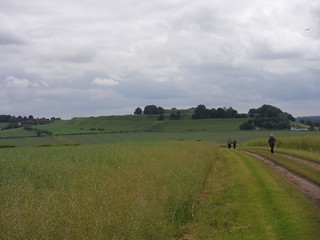
- [Map 9], [Map 10], [Map 11] Lake to Stonehenge. Cross the road, half-left to a two-fingered FP sign, and head due west along the top of the field with the wooded hillside on your left. This is the beginning of the bronze age landscape. (A more modern phenomenon is Sting's country mansion and remnant of a large man-made lake beneath you.)
This is the beginning of what some people may feel is a special part of the walk. You might like to walk it on your own all the way to Normanton Down and the bronze age barrows. Just a suggestion.
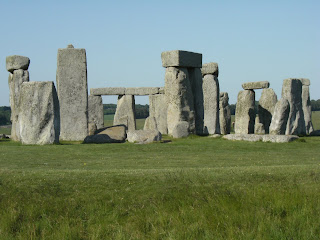
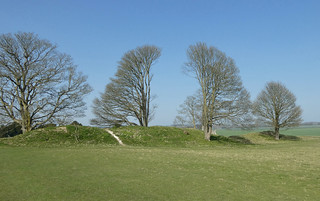
In more detail. The path traverses the wooded hillside which used to house a bronze age village settlement. The path turns right down to the road alongside a wire fence. At Lake Bottom (the name of the area) turn left along the track past the ruins of a small well house where the path turns gently right. Follow this extraordinarily wide byway for 1.5 kms to Springbottom Farm. What travellers have been this way before you? At the farm, follow the orange byway sign, not the yellow FP sign, left and then straight on ignoring a smaller way to the right and ignoring a broad driveway to the left. Continue northwards. The round barrow cemetery at Normanton can be seen briefly on the horizon. After a further 1.5 kms, the first view of Stonehenge emerges, an information board explains a little about the tumuli and the finds that have been made there. Strangely it does not mention the dates of the barrows which are from around 2600 to 1600 BCE. Stonehenge is thought to be several thousand years older than that.
- After the information board at Normanton Down you pass through a wooden farm gate and you have two choices (plus one to carry straight on, which you must not do because of danger from traffic on the main road ahead).
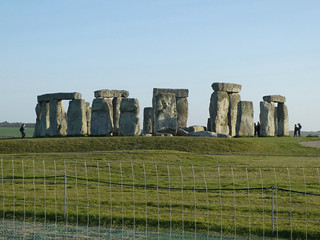
Option 1, [Map 12]. The recommended route to visit or get closer to the Stonehenge is to turn left (west) along a permissive path where you meet up with a parallel byway that enables you to cross the two main roads safely. At this point you may meet King Arthur Pendragon, head of the Druids whose main purpose in life is to have the fences around Stonehenge removed and more free access allowed to both the general public and Druid worshippers. He may be in residence in his mobile home. Crossing the second main road you can enter the car park passing the public conveniences and make your way to the small open-air cafe. Frankly these makeshift buildings are a disgrace to Britain and an insult to the tourists who visit the site but they do provide a reasonably priced cup of tea, scones and an ice cream. The cafe and admission to the inner site of Stonehenge close promptly and simultaneously with last admission some 45 minutes before closing. Opening times 16 Oct-15 Mar till 4pm, 16 Mar-31 May till 6pm, 1 Jun-31 Aug till 7pm. Note that Summer Solstice times are variable and may close early for the sake of public safety! Uniquely National Trust members can gain free access to this English Heritage site.
The druids were of course more interested in sunrises than sunsets. For anyone who has witnessed eclipses or druid sunrises you will know that the sense of anticipation is dramatic and the druids, and some modern day people, will celebrate these with whoops of joy, beating drums, whistles and shouting. Far too dramatic for and sanitised now by English Heritage. But be aware that if you do stay for the sunset you still have 5 kms to walk into Amesbury and some of it over rough ground.
Option 2, [Map 15] and [Map 16]. If you are not tempted to pursue a druidic celebration, are satisfied with a distant view of Stonehenge and don't want to get mangled by the tourist crowds, then you can take the permissive path right (east) directly to Amesbury via West Amesbury. This path wends its way along field boundaries to the south side of Amesbury (approx 3 kms) which you enter by crossing another bridge across the River Avon. You save 2 kms in distance.
- [Map 13] and [Map 14], Option 1 continued, Stonehenge to Amesbury. If the light is fading then you would be best advised to walk along the main roads east to Amesbury. However this is not a desirable route because of the heavy road traffic. The recommended walking route is to exit Stonehenge from behind the Visitors Cafe through a small wooden swing gate into the open field behind. There is a permissive right of way across the open fields to the broad gap in the trees on the horizon to the east north east (ENE). This is rough ground. After about three hundred metres you come to a wire fence in a dip, a farm gate and a small field gate with a FP arrow on it. Go through the gate and follow the direction of arrow precisely uphill across more rough field to the far side, the large gap in the trees on the horizon where you will find another small field gate. Turn left (north) for 250 metres and then right (east) to find your route now signposted to Amesbury. You have been following roughly the processional route called The Avenue, the route by which the bluestones may have been brought to Stonehenge from South Wales by one or other of the two river Avons. The one Avon passing through Stratford-upon-Avon, the other the river you have been previously walking beside which passed through Salisbury.
For the next 3 kms follow the stony farm track, ignoring all ways off, to a main road. Information boards describe how someone in the recent past has planted clumps of trees to illustrate the formation of ships in the Battle of the Nile. Fanciful or not these prove you are still on some kind of historical trail. You exit onto the road along side a five bar wooden field gate. Turn right (south) to follow the road into Amesbury town centre. (There is a bus stop here for the 5/6 service which would take you through Amesbury and on to Salisbury, but there is no timetable posted here and unless you have the printed timetable available – or ring Traveline Tel: 0871 200 22 23 – then it is better to continue into Amesbury where there is an additional bus service, the Activ8). Use the pedestrian underpass to cross the very busy A303. After a short uphill stretch you descend quickly and no doubt with some sense of relief into Amesbury.
Turn right down the High Street and the first pub on your right, The George, is recommended for a quick refresher. All the pubs in Amesbury are in a similar vein. Continue down the High Street and then left into Salisbury Road. The Bus Station is at the far end of this road. Catch either bus No.5/6 or bus Activ8 back to Salisbury. (Bus Activ8 does not stop at Old Sarum although you might persuade the bus driver to do so). On a Sunday they run at approx 1.5 hourly interval. Alternatively there are taxis.
In Salisbury, ask the bus driver to stop at Market Square then cross to Minster Street and follow the signposts to the railway station. On the way you will pass a Wagamama and then The Mill public house set back from the river, a good place to sit and observe a different type of wildlife in Salisbury. Allow yourself 10 minutes to walk to the station.
|